
“I Never Tapped Ribadu’s Phone” — El-Rufai Tells Court His Comments Were Political Rhetoric, Not Admission Of Crime
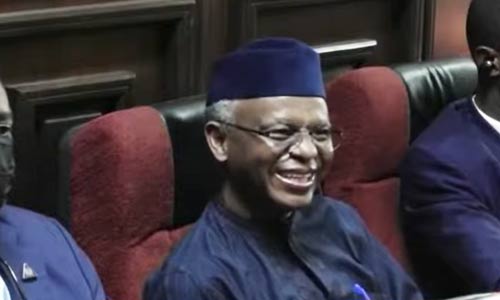
Former Kaduna State Governor, Nasir El-Rufai, has denied unlawfully intercepting the telephone conversations of the National Security Adviser (NSA), Nuhu Ribadu, telling the Federal High Court in Abuja that his earlier remarks suggesting that he and others listened to government officials’ calls were merely political rhetoric and not an admission of criminal conduct.
El-Rufai made the clarification on Wednesday, November 25, 2026, while testifying in his defence before Justice Joyce Abdulmalik in the ongoing criminal trial instituted against him by the State Security Service (SSS).
The former governor, who is facing five counts relating to alleged unlawful interception of communications and other cyber-related offences, maintained that he neither tapped Ribadu’s telephone nor instructed anyone to intercept his conversations.
Led in evidence by his counsel, Paul Erokoro, SAN, El-Rufai told the court that he had never owned equipment capable of intercepting telephone communications and possessed no technical knowledge of how such interception could be carried out.
He also denied having access to the NSA’s communication networks, telephone devices or other systems through which his conversations could be monitored.
Explaining the circumstances surrounding his controversial remarks during an interview on Arise Television in February 2026, El-Rufai insisted that his statements were intended as political expressions rather than factual admissions of illegal surveillance.
According to him, his use of the word “we” referred broadly to opposition politicians and was not intended to suggest that he personally participated in intercepting telephone conversations.
“I used ‘we’ to refer to opposition politicians. When I said ‘tapped’, it was an embellishment intended to make the government feel the pain we are feeling.
“It was rhetorical and exaggerated. My objective was to engage in political retort and linguistic flourish,” he told the court.
The criminal proceedings arose from an interview El-Rufai granted Arise Television’s Prime Time programme on February 13, 2026, a day after security operatives attempted to arrest him at the Nnamdi Azikiwe International Airport, Abuja, following his return from Cairo, Egypt.
Although the security operatives seized his passport during the encounter, they did not arrest him.
During the television interview, El-Rufai accused Ribadu of directing security operatives to arrest him, claiming that he became aware of the instruction after he and an unnamed person listened to a telephone conversation in which the NSA allegedly issued the directive.
When asked during the interview how he obtained the information, the former governor stated: “He made the call because we listen to their calls.”
He also acknowledged during the programme that intercepting telephone conversations without lawful authorisation constituted an offence.
The remarks subsequently prompted the SSS to institute criminal proceedings against him.
The security agency initially filed three charges against the former governor before amending the charge to five counts.
The allegations include unlawfully intercepting the NSA’s telephone communications, accessing classified information without authorisation, interfering with critical national information infrastructure and failing to report an individual allegedly involved in the interception.
The prosecution further alleged that El-Rufai and other persons still at large employed technical equipment or systems to intercept Ribadu’s communications in a manner capable of compromising public safety and national security.
The charges were brought under provisions of the Cybercrimes (Prohibition, Prevention, etc.) (Amendment) Act, 2024; the Nigerian Communications Act, 2003; and the Designation and Protection of Critical National Information Infrastructure Order, 2024.
El-Rufai pleaded not guilty to all five counts.
During the prosecution’s presentation of its case, two witnesses testified before the court, including lawyer and public commentator Deji Adeyanju.
Adeyanju told the court that he was present at Arise Television for a separate appearance on the day El-Rufai granted the controversial interview.
He confirmed that the recording played during the proceedings accurately reflected what he witnessed at the television station.
However, under cross-examination, Adeyanju acknowledged that El-Rufai did not expressly state that he had personally tapped the NSA’s telephone.
The witness nevertheless maintained that he heard the former governor say: “We listened to their calls.”
